I think we can all agree that mastering a foreign language as an adult is a long and challenging process. For many of us, at least part of this journey takes place in a controlled environment — such as a classroom — under the guidance of a teacher. This is what linguists call foreign language learning (as opposed to ‘acquisition’, which refers to a language being picked up naturally through exposure).
FLL typically involves learners completing a series of tasks (which the layman may call “exercises”) meant to support them on their way to proficiency: oral and written production, cloze tests, fill-in-the-blanks, true/false/not said, etc. So far so good.
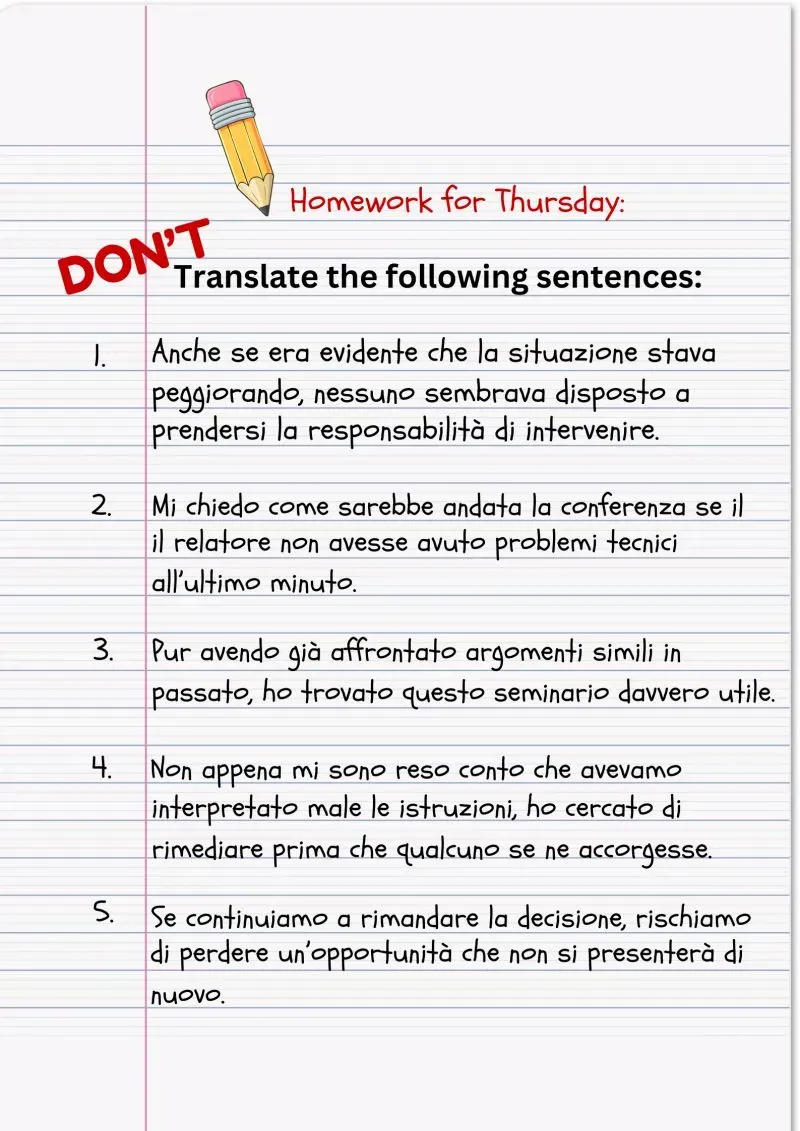
Every once in a while, though, some not-so-updated teacher — whose last training course likely took place in the 70s — has the brilliant idea to throw ✨TrAnSLAtiOn✨ into the mix.
I’ve seen this over and over. I’ll be tutoring a high schooler who can barely hold a conversation past “How are you? Fine, thanks,” in a foreign language, only to discover they’re somehow expected to complete absurd translation tasks… typically INTO that same foreign language. More often than not, these preposterous tasks even become the focus of monthly evaluations that young learners routinely fail.
I am fed up, so I’ll say it loud and clear.
Do not expect your students to translate (let alone evaluate them on their ability to do so) if:
1️⃣ you have never taught them how to translate — which, if you are a high school teacher, I can bet you haven’t
2️⃣ you have no idea how to grade a translation, and you are going to make it up based on how you feel on a random Tuesday after waking up on the wrong side of the bed
3️⃣ you are not a translator yourself and have no idea how hard translation actually is or what skills it requires.
You need to understand that by asking students to translate without any prior training, you’re reinforcing a false equivalence in their minds: knowing a language = being able to translate it effectively. This is simply NOT true. There’s a reason why people spend 5+ years at university training to become qualified translators. It is not something you improvise with a shaky B1 and the vocabulary you’ve seen in Unit 6. 🔍
So please, remove that translation exercise at the end of your two-hour test. No, don’t add it “just for bonus points,” either: it’s not fair. But if you do want to introduce translation to your high schoolers properly, try this:
✨ choose an appropriate text and hand out copies in class
✨ invest time in selecting a suitable translation strategy based on text type, target audience, and purpose
✨ translate together: students offer suggestions, and you write them on the board
✨ spend time finding culturally appropriate, context-dependent equivalents — it’s not just about grammar!
✨ evaluate possible alternatives as you go, discarding those that don’t align with the chosen strategy
✨ highlight at every step how languages package meaning differently.
Maybe — just maybe — someone will appreciate the process and one day become a passionate professional. But if all of this sounds like too much work, then kindly keep translation off the menu. Your students (and countless professionals) will thank you.