New Sunday, new church interpreting challenge.
What would you do?
Setting the scene:
You are selected to interpret a worship service simultaneously for an evangelical audience. For me, it was English into Italian, but for the sake of this post you can imagine it’s your strongest language pair. Eager to serve the Lord & test your interpreting skills, you accept the challenge.
On the given day, you show up early and sit in your chair. No booth, no boothmate. Just you sitting at the back with a copy of the Bible in your lap and a smartphone in your pocket.
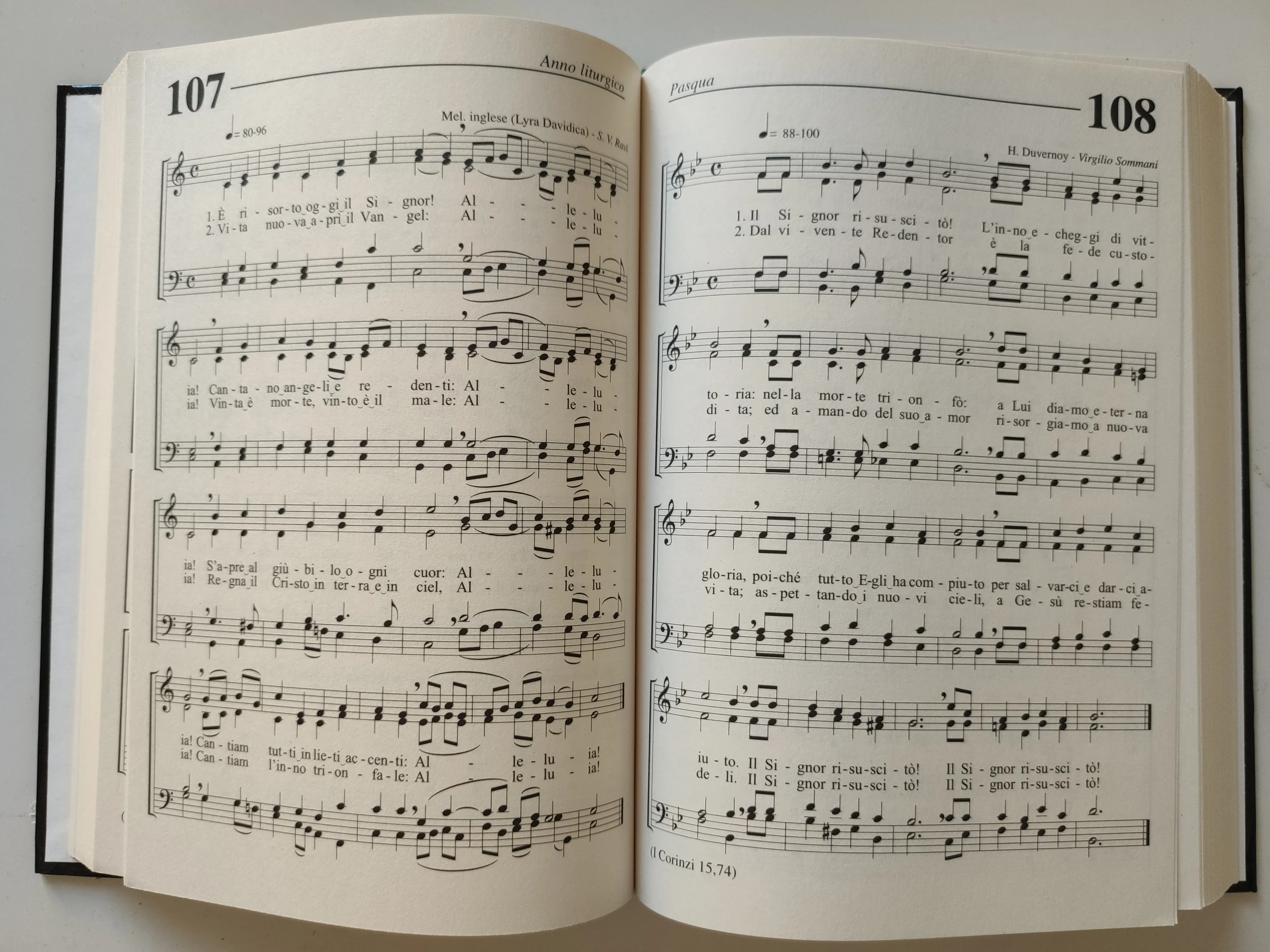
After a brief introductory prayer, the congregation is asked to stand to praise the Lord in singing. You glance down at the hymnal, which a good soul had cared enough to hand you at the entrance, and you see this.
Chopped up lyrics and archaic liturgical vocabulary. Your hymn dates back to the 16th century. And - if this weren’t enough - it is sung in the style of gregorian chants, so that - even though you master the source language - the lyrics are mostly unintelligible to the ear.
So, what would you do? 🤔
This case study is inspired by a real-life scenario I’ve faced as a professional interpreter. Here’s what I actually did in the moment.
My answer
It all depends on the congregation. When I serve at an Evangelical church, I don’t even think twice: I just turn my mike off and let the congregation enjoy the music. Why? Because in most charismatic churches, music plays a major role in enhancing the experience of God’s presence. No matter how linguistically accurate and theologically sound your translation is, if it hinders their connection with the Lord, trust me: they don’t want to hear it. Some members of the audience make this extra clear by just removing their earphones.
But this is not the case for every denomination. In other branches of Christianity, music is regarded differently. For instance, in Lutheran and Calvinist churches, hymns are typically taken from the book of Psalms or otherwise carry a strong theological significance. They are connected to specific moments of the liturgy, like the confession of sin or the profession of faith. If this is the case, then it is quite important for the audience to understand the content of the hymns so that they can meaningfully participate in the service.
An experienced church interpreter can easily tell the difference between these two kinds of attitudes towards singing just by looking at the layout of a church. Charismatic churches typically have a big screen at the front where lyrics are displayed for the congregation to sing along. Lutheran and Calvinist churches tend to have hymnals that are handed out one by one at the entrance. The latter is clearly our case, so we can’t just safely neglect the hymns.
What can we do instead?
Arrive at church at least fifteen minutes early and make sure to grab a hymnal at the entrance. Then, look around: these churches normally have a board near the pulpit where hymn numbers are displayed. Once you find it, go through the hymns one by one and sight translate them to ensure nothing catches you off guard during the service.